

Why December 25 Misses the Deeper Story
- Ruben Flores

- Dec 25, 2025
- 4 min read
How the Hebrew calendar reveals a hidden story — and why it points to September, not December 25
For more than 1,600 years, Christianity has celebrated the birth of Jesus on December 25. It’s familiar. Comforting. Wrapped in lights, music, and tradition.
And yet… when we pause and look closely, something feels off.
Neither the Bible, nor Jewish tradition, nor historical practice actually supports this date.
What’s fascinating is that the New Testament itself quietly contains all the tools needed to uncover a much more precise timeline:
The Jewish priestly calendar
Temple service divisions
The conception of John the Baptist
Jewish festivals
Even Roman history
When these pieces are aligned, a surprising truth emerges:
Yeshua was almost certainly born in late September, during the Jewish festival of Sukkot (the Feast of Tabernacles) — not in December.
This isn’t mystical speculation. It’s drawn directly from the biblical text itself.
A hidden key most people miss
The story doesn’t begin in Bethlehem. It begins in Jerusalem, inside the Temple, with an elderly priest named Zachariah.
The Gospel of Luke tells us something very specific about him:
“There was… a priest named Zacharias, of the division of Abijah.”— Luke 1:5
That detail matters more than it seems.
In the time of King David, the priesthood was divided into 24 rotating divisions, each serving in the Temple for one week at a time (1 Chronicles 24). Sacred service followed sacred time.
The eighth division was called Abijah.
And Zachariah belonged to it.
An announcement that anchors the calendar
While Zachariah was burning incense — a moment of stillness and devotion — the angel Gabriel appeared and said:
“Your wife Elizabeth will bear you a son.”— Luke 1:13
This moment isn’t floating in symbolic time. It’s anchored to the exact week Zachariah was serving.
Based on priestly rotations that begin in the Hebrew month of Nisan, the division of Abijah served in late Sivan / early Tammuz, which corresponds to June or July.
When Zachariah completed his service and returned home, Luke tells us:
“Elizabeth conceived.”— Luke 1:24
So the conception of John the Baptist takes place in early summer.
The timeline is now alive.
Six months later, everything shifts
Luke then gives us one of the most important clues in the entire story:
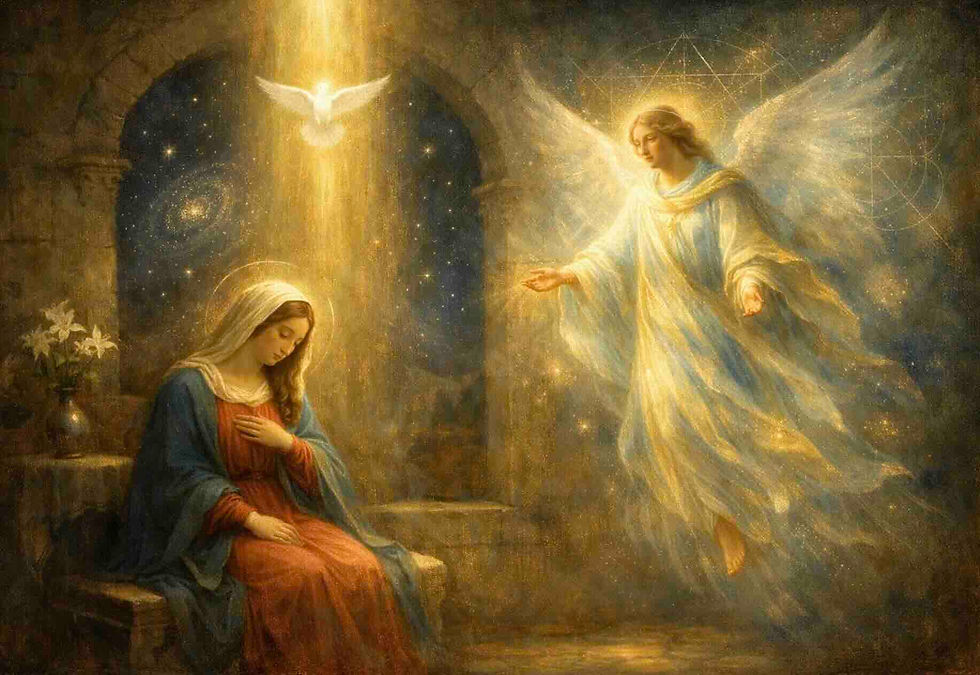
“In the sixth month [of Elizabeth’s pregnancy], the angel Gabriel was sent… to Mary.”— Luke 1:26
This is not the sixth month of the year. It’s the sixth month of Elizabeth’s pregnancy.
Six months after early summer brings us to late December or early January.
Which means something many people never notice:
December is not the season of birth. It is the season of conception.
Mary conceives in winter.
Following the rhythm of life
Nine months after conception brings us to late September or early October.
This places the birth of Yeshua in the Hebrew month of Tishrei, the most spiritually charged month of the Jewish year.
Tishrei contains:
Rosh Hashanah (New Year)
Yom Kippur (Day of Atonement)
Sukkot (Feast of Tabernacles)
Of all these, Sukkot stands out.
Why Sukkot matters so much
Sukkot is the festival of dwelling. For seven days, people leave their permanent homes and live in temporary shelters — sukkot — open to the sky. It’s a lived reminder that life is fragile, temporary, and held by grace rather than certainty.
This suddenly illuminates a famous line from the Gospel of John:
“The Word became flesh and dwelt among us.”— John 1:14
The Greek word used for “dwelt” is skēnoō — meaning to tabernacle, to pitch a tent.
This isn’t Christmas language. This is Sukkot language.
If the Messiah is born at Sukkot, the message becomes unmistakable:
Emmanuel — God with us. Not as theology. As calendar.
The shepherds tell the same story
Luke tells us that shepherds were:
“Living in the fields, keeping watch over their flocks at night.”— Luke 2:8
In Judea, shepherds do not sleep outdoors in winter. Winter nights are cold, wet, and harsh. The flocks are brought in.
But in late summer and early autumn, shepherds remain outside under open skies.
The night Luke describes is not a winter night. It’s an autumn night.

And the census? That too makes sense
Roman censuses required travel — lots of it.
Rome ordered them when:
Roads were passable
Inns were open
The weather was stable
Not in winter, when travel was dangerous and inefficient.
A December census simply doesn’t fit Roman administrative logic.
A stunning pattern begins to appear
When we step back, something remarkable emerges:
Event | Festival Alignment |
Conception of John | Late summer |
Conception of Yeshua | Winter |
Birth of Yeshua | Sukkot |
Ministry begins at 30 | Yom Kippur |
Death at 33 | Passover |
Spirit descends | Pentecost |
His life unfolds in harmony with Jewish sacred time — not Roman tradition.
This is not accidental. It is design.
So why December 25?
December 25 entered the story centuries later.
In the 4th century, Rome aligned the birth of Christ with:
Sol Invictus
Winter solstice festivals
Imperial unity efforts
Not because they believed he was born then, but because they wanted a shared cultural celebration.
December 25 is a political date — not a biblical one.
And it’s okay to say that.
Why this actually matters
This isn’t about disproving tradition. It’s about seeing the story clearly.
Through Jewish time. Not Roman time.
When we do, we discover something beautiful:
The precision of Scripture
The elegance of the festivals
A Messiah woven into the sacred rhythm of Israel’s covenant
Yeshua didn’t arrive in isolation. He arrived on time.

A final reflection: the tabernacle within
Whether Yeshua was born in a manger or a sukkah, whether the exact date is remembered or forgotten, the deeper meaning remains:
God does not dwell in temples of stone, but in the fragile shelters of the human heart.
Sukkot reminds us:
Life is temporary
Joy is sacred
Light returns after darkness
The divine is never distant
It pitches a tent beside us. Within us. Through us.
The birth is not a date. It is an event that repeats.
Every time love incarnates.
Every time forgiveness replaces fear.
Every time the heart becomes a home for the sacred.
An Invitation to Remember
The Bible never asked us to celebrate a birthday.
It invites us to recognize a pattern:
Light enters darkness
God dwells in human experience
The sacred unfolds through time
And the calendar — both Jewish and cosmic — tells the story.


Comments